Inflection Tables
If you already have a clear idea of what your inflection tables should look like, you can skip straight to building them in Tollerus. However if it seems daunting, then follow the steps below.
Step 1: Write a list of word forms
On a piece of paper or in a scratch document somewhere, choose an example word and write an exhaustive list of every synthetic form. If you can assign contrastive grammatical feature values to each one, even better.
TIP
"Synthetic form" here means a unique single-word form. For example compared to "speak", synthetic forms include "speaks," "spoke," and "speaking;" but "will speak" is a periphrastic form, not synthetic, because the difference is in a separate word "will."
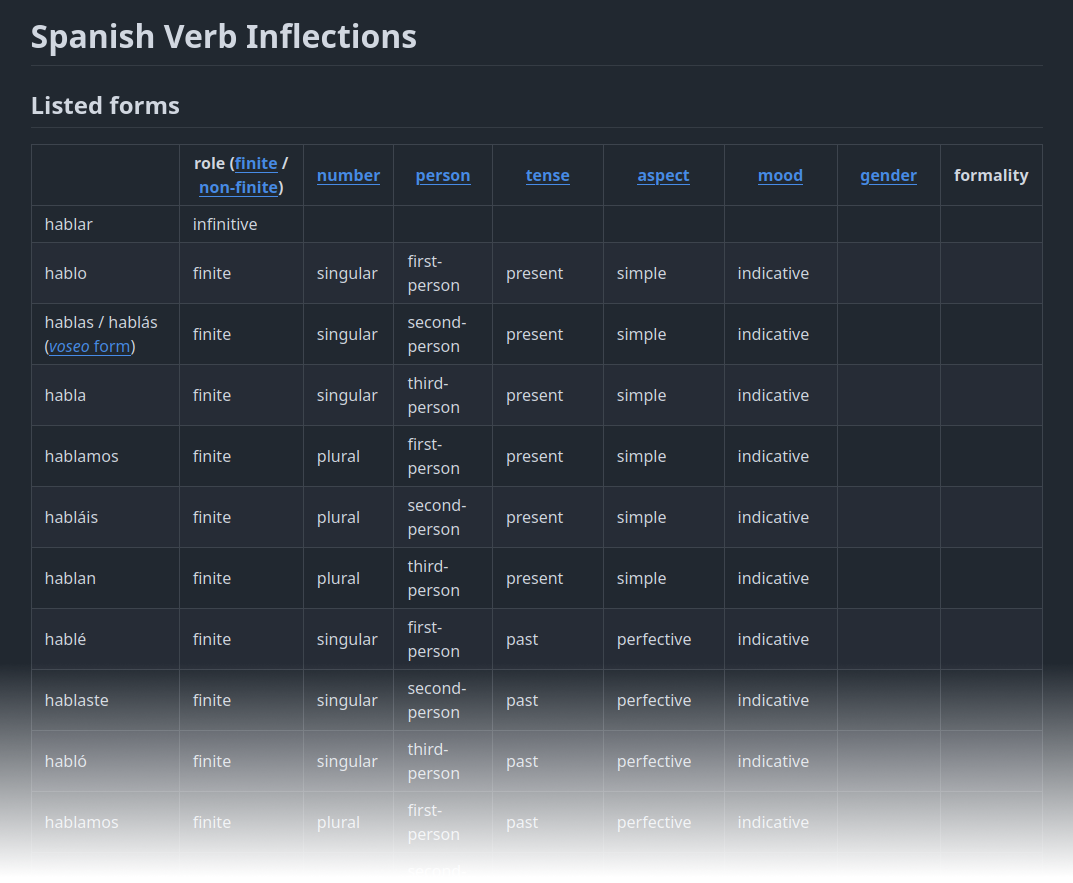
The example below shows synthetic forms of the Spanish verb hablar.
| Example: list of Spanish verb forms |
|---|
 |
Step 2: Merge duplicates
Try to spot any homonyms and merge them. Wherever the meanings differ, you can omit them or combine them with a slash.
For example in Russian, the genitive participle пишущего can be either masculine or neuter. Gender could be omitted from the scheme, except that the feminine пишущей is distinct, and the masculine пишущий and neuter пишущее differ in the nominative case. Therefore the gender of пишущего can be written as "masc./neu."
Step 3: Compact into inflection tables
The next step is to draft a set of inflection tables with maximum compactness/efficiency while retaining linguistic accuracy. Sometimes this takes a few tries before you find the optimal structure.
| Draft of Spanish verb inflection tables |
|---|
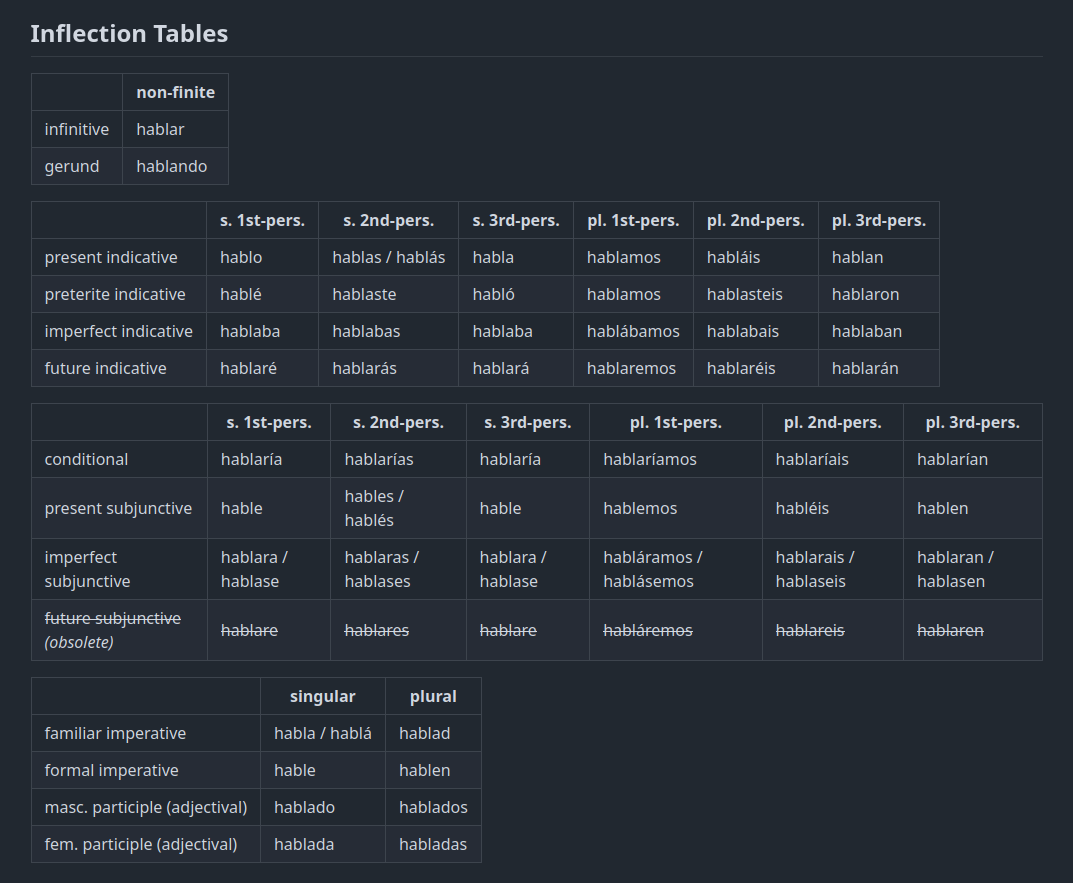 |
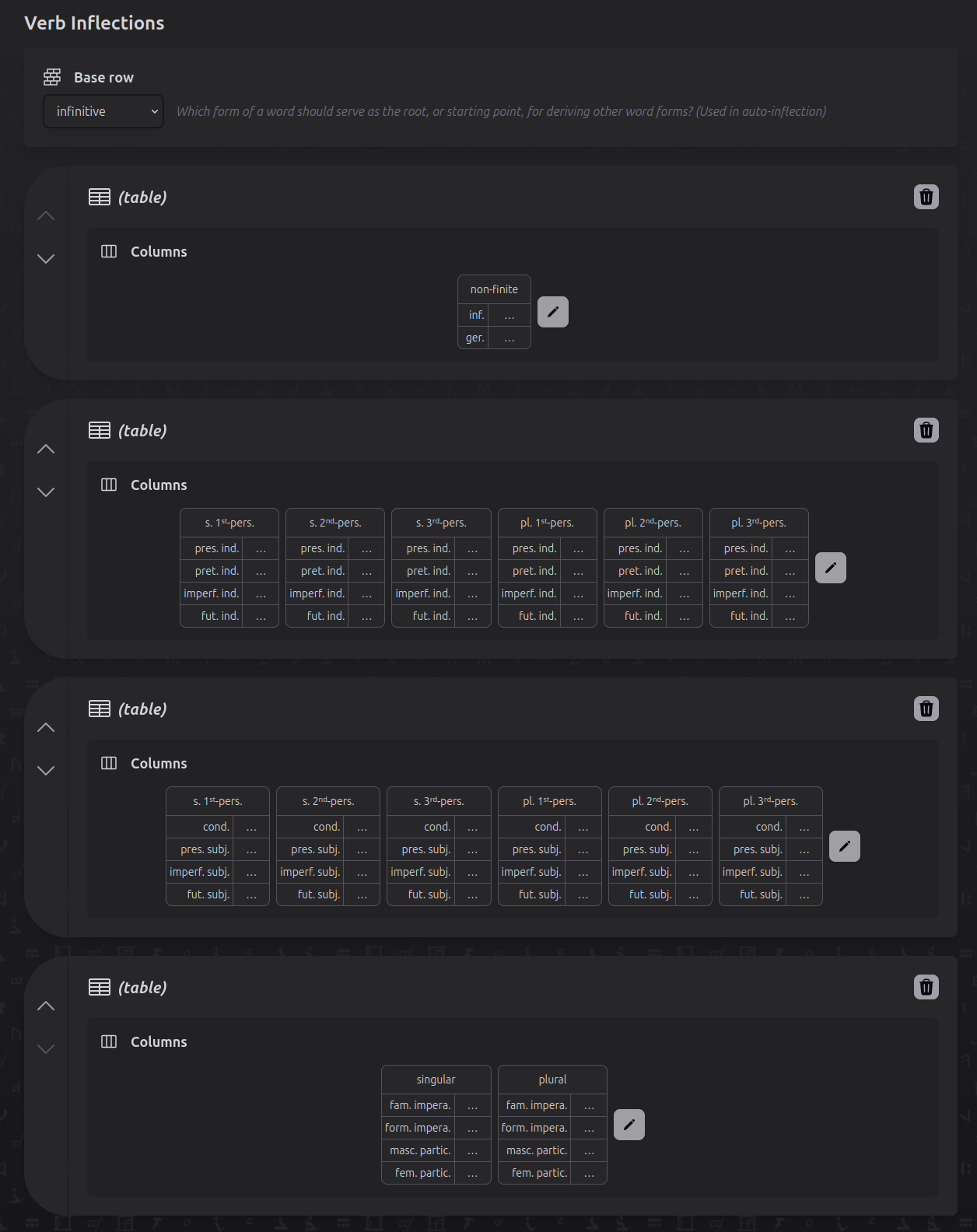
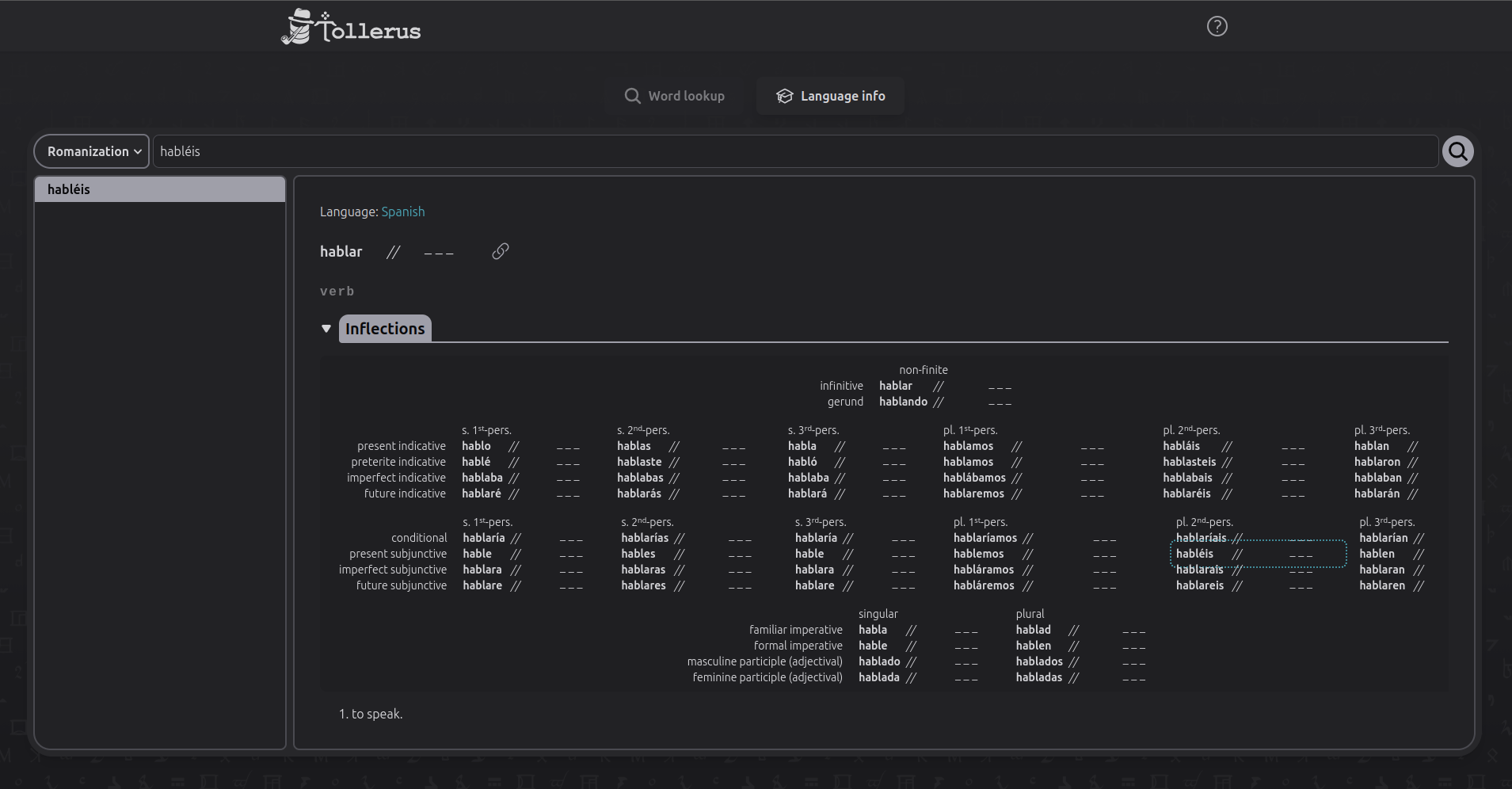
This is how the above draft tables look inside Tollerus:
| Admin config | Display for readers |
|---|---|
 |
 |
By default, if there are more than 30 inflection rows on a lexeme, Tollerus will put them all inside a collapsible section so the reader must click to see them. This helps avoid overwhelming the reader.
TIP
To adjust this threshold, see the public_inflections_max_rows key in your config/tollerus.php file.
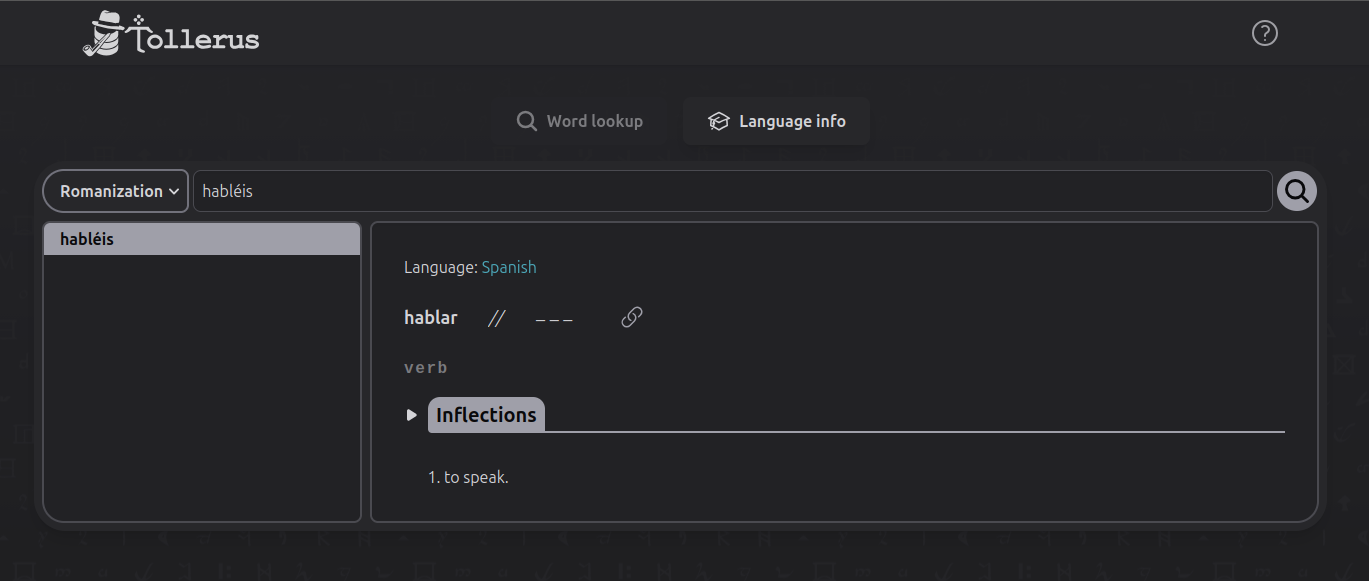
You can also hide tables/columns/rows entirely if you prefer:

However, you're encouraged to at least make the internal configuration exhaustive for synthetic forms. This is for two reasons:
- It makes it easier for you to capture complete data when adding word entries, and
- Hidden word forms are still searchable to readers.
So in the above example, even if habléis was hidden and inaccessible to a reader, they could still find hablar by searching habléis as shown.
For more guidance see Grammar Modeling Princples.
Next: Auto-Inflection